A touching birthday message to an old school friend works best when it names one specific thing you remember from your school years, keeps its warmth proportionate to how close you actually were, and closes without asking anything of them. If you haven’t spoken in years, shorter and more specific lands better than long and emotional.
An old school friend here means a person you knew during your school years and are no longer in regular contact with — not “old school” in the sense of old-fashioned or retro. That is also a different person from a childhood friend you grew up next door to, and a different person from a classmate you still see every week. The messages below are written for the friendship that has gone quiet.
Which message fits your situation
The right birthday message for an old school friend depends on two things: how long it has been since you last spoke, and how close the two of you actually were at school.
Most message lists ignore the second one, which is why so many of them sound wrong when you paste them into a text. A line like “you’ve always been my best friend” is genuinely moving from someone who was, and slightly embarrassing from someone who wasn’t.
Use this to find your section:
| You were genuinely close | You were friendly, not close | |
| Still loosely in touch | Warm, a few sentences — go to section | Warm, short — go to section |
| A couple of years quiet | Warm, one memory — go to section | Short, one memory — go to section |
| Ten years or more | Short, one specific memory — go to section | Short and light — go to section |
| Nothing since school | One specific line, no pressure — go to section | A simple wish — go to section |
The pattern running through that table: as the gap grows, the message gets shorter and more specific, not longer and warmer. That feels backwards to most people. It is the single most useful thing on this page.
Birthday messages for a school friend, by how long it’s been
A birthday message to a school friend you’ve lost touch with should get shorter and more specific as the gap grows: a few years apart still allows a warm few sentences, while fifteen years or more is usually best served by one concrete line.
The reason is simple. A long, emotional message implies a closeness that the silence contradicts. The reader notices the gap between the two, even if they can’t name what feels off. A short message with one real detail in it does the opposite — it proves you remember them without claiming anything that isn’t true anymore.
If you’re still loosely in touch
When you and an old school friend still exchange occasional messages or birthday texts, you can write warmly and at normal length, because the friendship is active enough to carry it.
- Happy birthday. Every year this date comes up and I’m glad we still do this.
- Happy birthday to the person I still measure “long friendship” by. Hope the day is a good one.
- Another year, another birthday text from me. Some traditions are worth keeping.
- Happy birthday. We don’t talk often, but you’ve been in my life longer than almost anyone, and that still counts for a lot.
- Hope your birthday is quiet or loud, whichever one you’re in the mood for. Thinking of you today.
- Happy birthday. Twenty-odd years of knowing you and I still think you’re one of the good ones.
If it’s been a couple of years
When two or three years have passed without real contact, a warm two- or three-sentence message works well, and you do not owe anyone an explanation for the gap.
That last part matters. People often spend the first half of their message apologizing for being a bad friend, which turns a nice moment into an awkward one. Skip it. Nobody keeps a ledger.
- Happy birthday. It’s been a while, but your name came up on my phone today and I was glad it did.
- Hope you’re doing well and that today’s a good one. Happy birthday.
- Happy birthday. Life got busy in both directions, I think. Hope this year is a kind one to you.
- It’s been too long, but happy birthday. I still think about how much easier school was with you in it.
- Happy birthday. No news, no agenda, just wanted to say I hope you’re doing well.
- Wishing you a really good year ahead. Happy birthday from someone who still remembers you fondly.
If it’s been ten years or more
After a decade or more without contact, a short message with one concrete detail in it lands better than a long one, because the detail does the emotional work that length cannot.
Ten years is long enough that the person receiving your message may be genuinely surprised. Surprise is fine. Surprise plus three paragraphs is a lot to receive on a Tuesday morning.
- Happy birthday. Still the only person I associate with the back row of [teacher’s name]’s class.
- Ten-plus years and I still remember your birthday. Hope it’s a great one.
- Happy birthday. Different lives now, but the school version of you was one of my favorite people.
- Hope life’s been good to you. Happy birthday from an old friend.
- Happy birthday. I have no idea what your life looks like now, but I hope it looks good.
- Saw the date and thought of you. Happy birthday.
If you haven’t spoken since school
When you haven’t spoken to a school friend since graduation, a short message that names one specific memory and asks nothing in return is more likely to be welcome than a long emotional note.
This is the highest-anxiety version of the situation, and the one people search for most. The worry is always the same: will this be weird? Usually it isn’t. A birthday message asks for nothing, arrives on a day the person is already receiving messages, and is easy to reply to or ignore. The lines below are built so that either response is fine.
- Happy birthday. Out of nowhere, I know — your birthday just stuck in my head all these years.
- Happy birthday from a very old school friend. Hope life turned out well for you.
- We haven’t spoken since school, but I remembered the date and thought I’d say it: happy birthday.
- Happy birthday. No reply needed. Just a good wish from someone who remembers you.
- Hope you’re well and that today’s a good one. Happy birthday, from way back.
- Happy birthday. Whatever the years have brought you, I hope most of it was good.
Messages for a school friend you were genuinely close to
If a school friend was genuinely close to you — the person you sat with every day or told everything to — a birthday message can carry more emotional weight, provided the warmth matches the friendship as it is now rather than as it was at sixteen.
The distinction is between honoring what the friendship was and claiming what it currently is. “You were one of the most important people of my teenage years” is true and safe. “You’re still my best friend in the world” may not be, and the reader will know.
- Happy birthday. You knew me before I had any idea who I was going to be, and I’ve never quite replaced that.
- Happy birthday to someone who was a huge part of the best years of growing up. I hope this one’s a good one.
- We’ve lived whole separate lives since school, and you’re still one of the people I’m gladdest to have known.
- Happy birthday. Whole chunks of my memory from back then have you in them.
- I don’t know if I ever told you how much easier you made those years. Happy birthday.
- Happy birthday. Different cities, different lives, but you were the real thing when it counted.
- Thinking of you today. You were one of the best parts of a complicated few years, and I’ve never forgotten it.
- Happy birthday. Whatever else changed, I’m glad the two of us happened.
Messages for a classmate you liked but weren’t close to
For a classmate you were friendly with but never close to, a birthday message should stay short and cordial, because language like “you’ve always been my best friend” will read as false to someone who remembers the friendship accurately.
This is the situation almost no message list is written for, and it is extremely common. You liked them. You were in the same class, the same team, the same lunch table. You were not each other’s person. A warm, small message is exactly right here — and a big one is worse than nothing.
- Happy birthday. Always liked seeing your name come up. Hope it’s a good day.
- Happy birthday from an old classmate. Hope life’s treating you well.
- Wishing you a good birthday and a better year. Nice to still be in each other’s orbit.
- Happy birthday. We were never close, but I always thought you were one of the decent ones.
- Hope you have a great one. Happy birthday.
- Happy birthday. Small wish from an old classmate, but a genuine one.
Short birthday lines for an old school friend

A short birthday message to an old school friend works when it is warm, specific to them, and under about fifteen words, which makes it suitable for a text or a public post.
Short does not mean careless. These are written to be sent as-is.
- Happy birthday, old friend. Hope it’s a good one.
- Same date, same wish, every year. Happy birthday.
- Happy birthday from the back of the classroom.
- Still remember. Still glad. Happy birthday.
- Happy birthday to my oldest friend on this list.
- Hope today’s a good one. Thinking of you.
- Happy birthday. Long time, still counts.
- From an old school friend: have a great one.
How to make the message sound like yours
To make a birthday message to an old school friend sound like yours, replace general warmth with one concrete detail only the two of you would recognize — a place, a person, an object, or a routine from your school years.
This is the difference between a message that could have been sent to anyone and one that could only have been sent to them. It takes about ten seconds.
Step 1 — Pick one detail, not three. One is specific. Three is a nostalgia dump. Reach for one of four categories:
- A place — the hallway, the parking lot, the field behind the gym, the diner everyone went to after school. If you were at college together, the equivalents are the dorm, the library floor you lived on, the bar everyone ended up in.
- A person — a teacher, a coach, a bus driver, a professor, a mutual friend
- An object — a car, a jacket, a song that played constantly, a lunch table
- A routine — the walk home, the seat you always took, the class you both dreaded
Step 2 — Reference it in passing, don’t explain it. A shared memory works because you both already know the story. Retelling it turns a warm nod into a paragraph.
Step 3 — Attach it to the wish, not the other way around. The birthday is the reason for the message. The memory is the proof it’s from you.
Here is what that looks like:
| Generic | With one detail |
| “Happy birthday! So many great school memories with you.” | “Happy birthday. Still can’t hear that song without thinking of your car.” |
| “We had such good times back in school.” | “Happy birthday from your old lab partner. I still have no idea how we passed.” |
| “You were always such a great friend.” | “Happy birthday. You’re the reason I made it through sophomore year math.” |
| “Thinking of you on your special day!” | “Happy birthday. Thought of you when I drove past the old school last month.” |
If you can’t remember anything specific
When no particular memory comes to mind, name the shared context instead of inventing a moment — the class, the team, the year, or a mutual friend works just as well.
“Happy birthday from your old bandmate” carries the same signal as a detailed anecdote. It says I know exactly who you are. You can also route through someone else: “Ran into Chris last year and we ended up talking about you. Happy birthday.”
What doesn’t work is manufacturing a memory you don’t actually have. The person on the other end was there too.
Choosing the right length for where you’re sending it
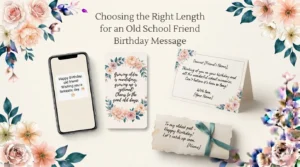
The right length for a birthday message to an old school friend depends on where you send it: one line for a public social post, one to three sentences for a private text or direct message, and a short paragraph for a greeting card.
Visibility matters as much as length. A comment on a public birthday post is read by dozens of people, including the friend’s family and coworkers, so it should stay light. A private message can be more personal precisely because nobody else is reading it.
| Where you’re sending it | Length | Who sees it | What changes |
| Public post or comment | One line | Everyone | Keep it warm and general; save the personal detail for a private message |
| Text or direct message | One to three sentences | Just them | The best place for a specific memory |
| Greeting card | Short paragraph | Them, maybe their household | You have room; use it for one memory and one genuine wish |
| Handwritten note | Short paragraph | Just them | The effort is part of the message; keep the words plain |
| Voice note | 15–30 seconds | Just them | Warmest option, but harder to receive; best if you were genuinely close |
One practical note on public posts: a very personal message posted publicly can put the recipient in the awkward position of responding in front of an audience. If the thing you want to say is specific and emotional, send it privately.
How to close it without putting them under any pressure
To close a birthday message to an old school friend without creating obligation, end with a wish rather than a question, since an open-ended line lets them reply if they want to and lets the message stand on its own if they don’t.
There are three ways to finish, and they carry different levels of expectation:
A clean wish — no expectation. “Hope it’s a great one.” “Wishing you a good year ahead.” The message is complete in itself. Nothing is owed.
A soft door-open — low expectation. “Hope life’s been good to you.” “Would be good to hear how you’re doing sometime.” An invitation they can accept or let pass without it becoming a thing.
An explicit invitation — real expectation. “Would love to catch up properly — are you still in the area?” Warmer, but it does ask something of them, and it turns a birthday message into the start of a conversation you need to be ready to have.
Using a birthday as the occasion to reconnect is a recognized approach, not an odd one — the practitioner-reviewed guidance in wikiHow’s advice on reaching out to someone you haven’t talked to in a long time specifically names using a special occasion such as a birthday as a natural opening. Just be deliberate about which of the three closings you use. Most people reaching out after a long gap want the first or second, and reach for the third out of politeness.
What makes a heartfelt message land badly
The most common mistake in a birthday message to an old school friend is overclaiming closeness — describing a friendship in present-tense terms that the years of silence contradict.
Here are the failures worth knowing, and what to write instead.
Overclaiming closeness. “You’ll always be my best friend” sent to someone you haven’t spoken to in twelve years reads as a script, not a sentiment.
Instead: put the closeness in the past tense where it’s true. “You were one of my favorite people back then.”
Guilt-tripping. “It’s been so long! You never message anymore!” — even said lightly, this makes the reader responsible for the gap on their own birthday.
Instead: let the gap be nobody’s fault. It usually isn’t.
The nostalgia dump. Four memories in a row turns a birthday wish into a monologue.
Instead: one detail. Save the rest for if they reply.
The unsolicited life update. They didn’t ask what you’ve been doing since 2011.
Instead: keep the message about them. If they want your news, they’ll ask.
The hidden ask. A warm birthday message that arrives three lines before a request — a job lead, a referral, an invitation to something you’re selling — damages the friendship and the message at once.
Instead: if you need something, ask on a different day. Not their birthday.
Warmth out of proportion to contact. A long, emotional paragraph after years of silence can read as performance rather than feeling.
Instead: match the temperature to the actual friendship. Shorter is often warmer.
Generic filler. “Wishing you happiness, health and success on your special day” could go to anyone, and the reader can tell.
Instead: one specific thing. Anything specific.
One more, easy to miss: if you’re writing to an old classmate of the opposite sex and you weren’t especially close, keep the wording plainly friendly. “Always had such a soft spot for you” reads differently out of the blue than you intend it to.
Milestone birthdays for an old school friend
A milestone birthday — a 30th, 40th, 50th or 60th — is one of the few occasions where a longer message to an old school friend is welcome even after a long gap, because the round number gives the contact an obvious reason to exist.
Milestone messages also get re-read. People screenshot them, keep the card, come back to it later in the week. That is worth an extra sentence.
- Happy 30th. The version of you I knew at seventeen would be pretty pleased with how this turned out.
- Happy 40th. Genuinely strange that we’re this old, and genuinely nice that I still know you.
- Fifty. We met when we were both about eleven, which is a slightly alarming piece of arithmetic. Happy birthday.
- Happy 60th. Long way from the school parking lot. Hope it’s a good day surrounded by good people.
- Happy 40th to one of the people I’ve known longest. That gets rarer, and it means more than it used to.
- Big one this year. Hope it’s celebrated properly. Happy birthday from an old school friend.
Situations that need different wording
If you’re a day or two late
A belated birthday message to an old school friend is still worth sending, and a brief, unfussy acknowledgment of the delay works better than an elaborate apology.
- A day late and still meant it. Happy birthday.
- Missed the actual day. Didn’t miss the thought. Hope it was a good one.
- Belated happy birthday. Hope the day was everything you wanted.
If they might not remember you
When you’re unsure whether an old classmate will remember you, include a short identifier — your name and the shared context — so the message doesn’t put them in the awkward position of guessing.
This is worth doing even when you think it’s obvious. People remember faces more reliably than phone numbers, and a number they don’t recognize can turn a kind message into a puzzle.
- Happy birthday! It’s [name] — we were in [class or team] together. Hope you’re doing well.
- Not sure if this number’s still yours, or if you’d place me. [Name], from [school]. Happy birthday either way.
If things ended badly between you
When a school friendship ended in conflict, a birthday message should be short, warm and free of any reference to what happened, because a birthday is not the right occasion to reopen it.
Keep it to a wish. If they want to talk, the door is now slightly open. If they don’t, you’ve done nothing wrong.
- Happy birthday. Genuinely hope you’re doing well.
- Thinking of you today. Wishing you good things.
If they’re going through a hard year
When an old school friend is dealing with grief, illness or another difficult stretch, a birthday message should acknowledge the year lightly and avoid forced cheerfulness.
- Hope this year is a gentler one than the last. Thinking of you today.
- Happy birthday. No performance required. Just wanted you to know I was thinking of you.
- Wishing you a quiet, good day. You’ve earned an easier stretch.
If you’re writing in a class group chat
In a school or alumni group chat, a birthday message should be short and specific rather than long, because the recipient is reading many messages at once and the specific ones are the ones they remember.
Ten people will write “happy birthday 🎉.” One detail makes yours stand out without any extra effort.
- Happy birthday! Still the fastest person in our year, as far as I’m concerned.
- Happy birthday from the group chat. Hope it’s a great one.
- Happy birthday! Officially the oldest of us again. Rules are rules.
What usually happens after you send it
After sending a birthday message to an old school friend, there are three likely outcomes — a brief thank-you, a longer catch-up reply, or no reply at all — and a reply is never guaranteed, so silence is usually not worth reading as rejection.
If they send a brief thanks. That’s a complete response. “Thanks!” or a heart reaction is a normal way to receive a birthday message, and it doesn’t mean the message misfired. You can leave it there.
If they reply warmly and ask how you are. Answer briefly and ask something back. A short, specific answer — one or two sentences about where you are and what you’re doing — leaves room for them to keep going. A full life history tends to end the conversation rather than start it. If you want to see them, say so simply and give them an easy way to decline.
If they don’t reply. People miss messages, especially on their birthday when everything arrives at once. They may be in a period of their life where replying to old friends is more than they can manage. Non-response is a familiar experience — one person describing exactly this in a Reddit discussion about sending a birthday text to an old friend reached out, received nothing back, and framed it as having done what they could. That’s the right frame. You sent a kind message that asked for nothing, which means nothing was lost.
Frequently asked questions
How do you wish an old classmate a happy birthday?
Keep it short and friendly, name yourself if there’s any chance they won’t place you, and avoid claiming a closeness you didn’t have. “Happy birthday! Hope life’s treating you well” is a complete and appropriate message for a classmate you liked but weren’t close to.
How do you say happy birthday to a very old friend?
For a friend you haven’t spoken to in ten or more years, send one short message containing a single specific memory and no request. Something like “Happy birthday. Still associate you with the walk home from school. Hope life’s been good to you” says everything a longer message would, without the weight.
How do you wish old school friends in a group chat?
Write one short line with a detail only that group would recognize. In a chat where a dozen people are posting the same generic wish, a specific reference to a shared class, team or moment is what the recipient actually remembers.
How do you write a heart touching birthday message?
A message becomes genuinely touching through specificity rather than intensity. Name one real thing you remember about the person, say it plainly, and don’t oversell the feeling — one honest, concrete sentence moves people more reliably than a paragraph of elevated language.
Is it weird to send a birthday message after years of no contact?
Sending a birthday message after a long gap is a low-risk gesture, because it asks nothing of the recipient and arrives on a day they’re already receiving messages. The worry is common — a Reddit thread asking whether it’s strange to wish someone a happy birthday after a year of silence drew the practical response of keeping it casual and short, with the worst realistic outcome being no reply.
Who this page is for
The messages here are written for someone sending a birthday wish to a friend from their school years who they’re no longer in regular contact with — including friends they haven’t spoken to since graduation.
If you’re writing to a friend you still see regularly, a childhood friend from your neighborhood rather than your school, or a current classmate, the wording here will read as more distant than you need. And if what you’re really after is a way back into the friendship rather than a birthday message, a birthday is a good opening but a poor conversation — send the short wish, and start the real catch-up afterward.
There’s also no obligation here. Sending nothing is a legitimate choice, and for some old friendships it’s the honest one. If the thought of sending a message makes you feel worse rather than better, that’s useful information.