
The standard way to wish a friend a happy birthday in Urdu is سالگرہ مبارک ہو (saalgirah mubarak ho) — literally “blessed year-knot”, from saalgirah, the anniversary of a birth. آپ is the respectful default, تم the familiar one; if your friend is Indian, جنم دن مبارک (janam din mubarak) is safer, because سالگرہ reads as “anniversary” there.
What to send a friend on their birthday in Urdu
سالگرہ مبارک ہو is the phrase to send. It is the standard Urdu birthday greeting, and it works as a complete message on its own or as the opening of a longer one.
Two words carry it. سالگرہ (saalgirah) means “birthday” or “anniversary”, and مبارک (mubarak) means blessed or congratulations. Put them together and you have a wish.
Everything else on this page is a refinement of that one line: how to address it, how to say it aloud, and which versions to avoid.
The one line that always works
آپ کو سالگرہ مبارک ہو، [نام]!
Aap ko saalgirah mubarak ho, [naam]!
“Happy birthday to you, [name]!”
Say it: long “aa” in saal, short “u” in mubarak (see How to say it out loud)
Register: respectful — safe for any friend
Sender gender: no change
Best for: any friend, including one you have not known long
This line is the safe default because it does not depend on how close you are. آپ is the respectful form of “you,” used with plural verb forms even when you are addressing one person, so it never sounds too familiar and never sounds cold.
If you want the shorter version, سالگرہ مبارک ہو works alone. Add the name in front of it and it reads as a personal message rather than a greeting card.
A note on تُو. Urdu has three levels of “you” — تو (tu), تم (tum), and آپ (aap) — and تو sits at the informal end. It is the form close friends and family use with each other, and it reads as disrespectful when it is not earned. If you are not certain the friendship is at that level, stay on آپ. No one has ever been offended by a birthday wish that was slightly too polite.
The next section sets out which level suits which friendship.
<a id=”how-to-say-it”></a>
How to say سالگرہ مبارک ہو out loud
سالگرہ مبارک ہو is spoken as three words — saalgirah, mubarak, ho — with a long “aa” in saal, as in “father”, and a short “u” in mubarak, as in “book”.
Those two vowel lengths do most of the work. Stretch the “aa” for a full beat and keep the “u” quick and crisp, then link the words in one breath without pausing between them.
That is the guidance this page can give you reliably. A word-by-word stress guide for every line would need a native speaker to record and check it, and a written approximation is not the same thing as hearing it. If you plan to say the wish aloud, the most useful thing you can do is listen to an Urdu speaker say سالگرہ مبارک ہو once and copy the rhythm.
The phrase is built into every line on this page, so a sender worried about pronunciation can use any of them and still rely on this section.
How to write it in Urdu script and in Roman letters
Pick whichever your friend can read.
Urdu script
سالگرہ مبارک ہو
Roman Urdu — رومن اردو, Urdu written in Latin letters
Saalgirah mubarak ho
Aap ko saalgirah mubarak ho
You will see the first word spelled several ways in real messages — saalgirah, salgirah, salgeerah — because there is no single official Roman scheme. Any of them will be understood. Use one spelling consistently within a message so it does not look careless.
One warning about transliteration. Writing an Urdu phrase by copying English sounds produces nonsense. “Happy birthday” written out phonetically is not Urdu, and sending it would read as a joke you did not intend. Use the Urdu phrase and transliterate that.
Which Urdu birthday wish to send, depending on how close you are
سالگرہ مبارک ہو suits any friend, but closeness changes the words around it: آپ keeps the wish respectful for a polite or older friendship, تم is the familiar form peers use, and تُو is very informal and reads as rude if you get it wrong.
The greeting itself never changes. Only the address does.
| Closeness | Address | Say this | Reads as |
| Casual, new, colleague, older friend | آپ | آپ کو سالگرہ مبارک ہو | Respectful and warm |
| Close peer, same age | تم | تمہیں سالگرہ مبارک ہو | Friendly, the way peers talk |
| Close but you want the warmth explicit | either | میرے دوست، سالگرہ مبارک ہو (mere dost, saalgirah mubarak ho) | “My friend, happy birthday” |
| A friendship where you already use endearments | — | see What not to send before you do | — |
دوست (dost) or یار (yaar)? Both mean friend. دوست is the standard, neutral word and is the safe choice in a written message. یار is warmer and more informal, and it appears constantly in spoken Urdu and in poetry. If you are writing to someone you would call a close friend, یار is natural. If you are not sure, دوست is never wrong.
Urdu birthday wishes for a friend: simple, prayerful, funny and poetic

There are four kinds of Urdu birthday wish you can send a friend — a simple one-liner, a wish with a prayer in it, a funny line, and a short two-line blessing — and every line below is given in Urdu script with its Roman spelling, its English meaning and who it is safe to send it to.
Three rules apply to everything in this section.
- Nothing here is romantic. This page is for friends. The romantic endearments are named in What not to send so you can avoid them.
- Every line tells you who it suits. A line that is perfect for a best friend can be strange with someone you met last month.
- The English meaning is given for every line, so you always know what you are sending before you send it. Sending words you cannot read is the one thing this page will not ask you to do.
Simple birthday wishes for a friend
سالگرہ مبارک ہو
Saalgirah mubarak ho
“Happy birthday”
Register: neutral · Sender gender: no change · Best for: anyone
آپ کو سالگرہ مبارک ہو
Aap ko saalgirah mubarak ho
“Happy birthday to you”
Register: respectful · Best for: any friend
میرے دوست، سالگرہ مبارک ہو
Mere dost, saalgirah mubarak ho
“My friend, happy birthday”
Register: warm, still respectful · Best for: a friend you know well
آپ کا دن خوشیوں سے بھرا ہو
Aap ka din khushiyon se bhara ho
“May your day be full of happiness”
Register: warm · Best for: any friend
Wishes with a prayer in them
Each line below is labeled with the name of God it uses. That label matters if you are not Muslim and want to know exactly what you would be saying.
اللہ آپ کو سلامت رکھے
Allah aap ko salamat rakhe
“May God keep you safe”
Uses: اللہ (Allah) — the specific Islamic name · Best for: a Muslim friend
خدا آپ کو خوش رکھے
Khuda aap ko khush rakhe
“May God keep you happy”
Uses: خدا (Khuda) — the Persian-derived Urdu word for God
Best for: any friend, including one who is not Muslim
آپ ہمیشہ خوش رہیں
Aap hamesha khush rahen
“May you always stay happy”
Uses: no name of God · Best for: any friend, with no religious framing
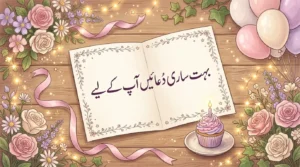
بہت ساری دعائیں آپ کے لیے
Bohat saari duaein aap ke liye
“Many prayers for you”
Uses: دعا (dua, prayer) but names no deity · Best for: a friend who welcomes a spiritual tone
Why خدا and اللہ are worth telling apart. Khuda is the Urdu word for God, borrowed from Persian, while Allah is the specific name used in the Qur’an — and usage in Pakistan has shifted toward “Allah” over recent decades. Both are acceptable. A published ruling from Darul Ifta Deoband states that the word Khuda may be used, noting that such names are not the sign of any other religious community. So if you are not Muslim and want to wish a Muslim friend well without invoking a name that is not yours, خدا or a line with no deity at all is the honest choice — and most friends will simply hear the warmth.
Funny and teasing wishes
Teasing works in Urdu the way it works in English: it lands when the friendship is genuinely a teasing one, and it misfires when it is not. Only send these to a close friend.
The jokes are usually about age, cake, and candles. Here is one gentle version:
سالگرہ مبارک! ایک سال اور بڑے ہو گئے، مگر دل اب بھی جوان ہے۔
Saalgirah mubarak! Ek saal aur bade ho gaye, magar dil ab bhi jawan hai.
“Happy birthday! You’re a year older, but your heart is still young.”
Register: affectionate teasing, respectful address throughout · Best for: a close friend
Notice that the line is built on آپ (bade ho gaye), not تُو. That is deliberate. A joke carried in respectful grammar is affectionate; the same joke in تُو can tip into impertinence. When in doubt, keep the joke and raise the register.
Two-line blessings, with translations
A note on words. In Urdu, شاعری (shayari) is verse generally, while a شعر (sher) is one couplet — the smallest complete unit of a poem. Everything below is a two-line blessing rather than an attributed couplet by a named poet.
That distinction is deliberate. Reproducing an individual poet’s work would need the poet’s name and, in most cases, permission, and a birthday message is the wrong place to be vague about whose words you are sending. Each blessing below is built from the standard phrases you have already met on this page.
آپ کی سالگرہ مبارک ہو
آپ ہمیشہ خوش رہیں
Aap ki saalgirah mubarak ho / Aap hamesha khush rahen
“Happy birthday to you — may you always stay happy.”
Register: respectful throughout (آپ) · Best for: any friend
تمہیں سالگرہ مبارک ہو
تم ہمیشہ خوش رہو
Tumhein saalgirah mubarak ho / Tum hamesha khush raho
“Happy birthday to you — may you always be happy.”
Register: familiar (تم) · Best for: a close friend
آپ کی زندگی خوشیوں سے بھری ہو
اور ہر دن پہلے سے بہتر ہو
Aap ki zindagi khushiyon se bhari ho / Aur har din pehle se behtar ho
“May your life be filled with happiness, and may each day be better than the one before.”
Register: respectful throughout · Best for: any friend
If you want your message to carry your own words rather than a borrowed line, combine a simple wish with something specific to the two of you — a shared joke, a place, a year. That is what makes a birthday message read as sent rather than forwarded, and in any language it is the part that cannot be copied from a website.
Does the wish change if your friend is a woman?
دوست is the same word whether your friend is a man or a woman — Urdu shows the gender in the word before it, so meraa dost is a male friend and merii dost is a female one, and the same pattern gives you pyare for a male friend and pyari for a female one.
The greeting سالگرہ مبارک ہو does not change. Only the words around it do.
| What you want to say | To a male friend | To a female friend |
| My friend | میرا دوست (meraa dost) | میری دوست (merii dost) |
| Dear friend | پیارے دوست (pyare dost) | پیاری دوست (pyari dost) |
| My friend, happy birthday | میرے دوست، سالگرہ مبارک ہو | میری دوست، سالگرہ مبارک ہو |
The Urdu word دوست is recorded as masculine or feminine, with the female equivalent given as دوست or سہیلی — which means gender is carried by agreement, not by a different noun. That is why the table above changes the adjective and leaves the noun alone.
If you are writing the message yourself, does your gender matter?
Yes. Urdu verbs in the first person agree with the gender of the person speaking, so a woman writing her own line uses a different form than a man does.
| If you are a man | If you are a woman | |
| “I wish you…” | میں چاہتا ہوں (main chahta hoon) | میں چاہتی ہوں (main chahti hoon) |
This matters because Urdu birthday messages circulate widely as ready-made text. If you copy one and send it unchanged, the verb form was chosen by whoever wrote it originally. Check the first-person verbs before you send. One letter separates chahta from chahti, and it is the difference between a message that sounds like yours and one that sounds like a forward.
سہیلی: the word for “female friend”, and why you may not want it
سہیلی (saheli) is the Urdu noun for a woman’s female friend, but speakers now generally regard it as old-fashioned and prefer دوست with the feminine adjective.
The word is still recorded in dictionaries with that meaning, and you will find it in older poetry and in some regional speech. Among contemporary speakers, though, the shift away from it has been noted by people who speak the language daily, who describe دوست as the word women now use for their female friends. Treat that as a usage note rather than a rule: if your friend uses سہیلی herself, use it with her.
Writing it and sending it: script, name, and voice note
Send the wish in whichever script your friend actually reads — Urdu script if she reads Urdu, Roman Urdu if she speaks the language but does not read the script, and a half-English version if your friendship runs in English.
You almost always know the answer to this, which is why the decision is yours rather than a general rule.
Should you write it in Nastaliq or Roman letters?
Nastaliq (نستعلیق) is the calligraphic style in which Urdu is ordinarily written, and it looks beautiful in a card or a printed message. Roman Urdu uses Latin letters.
| Does your friend read Urdu script? | Send | Why |
| Yes | Urdu script, ideally in Nastaliq | It reads as genuine and personal |
| No, but she speaks Urdu | Roman Urdu | She will read it fluently and hear the words |
| She does not read Urdu at all | Mixed — a short Urdu line plus English | She gets the gesture and the sense |
| You are not sure | Roman Urdu, or both | Neither choice can go wrong |
One practical caution. Urdu script can display inconsistently depending on the device, the app, and the font installed — and a friend reading on a phone that renders it poorly may see the message as broken characters. Sending a Roman transliteration alongside costs you nothing and guarantees she can read it.
Copy-paste blocks with the name filled in
Replace [نام] with your friend’s name. In Urdu script the name sits where the bracket is; in Roman, write the name in your own alphabet.
Respectful, for any friend
آپ کو سالگرہ مبارک ہو، [نام]!
Aap ko saalgirah mubarak ho, [naam]!
“Happy birthday to you, [name]!”
Warm, for a friend you know well
میرے دوست، آپ کو سالگرہ مبارک ہو۔ آپ کا دن خوشیوں سے بھرا ہو۔
Mere dost, aap ko saalgirah mubarak ho. Aap ka din khushiyon se bhara ho.
“My friend, happy birthday to you. May your day be filled with happiness.”
With a prayer, for a Muslim friend
سالگرہ مبارک ہو، [نام]! اللہ آپ کو سلامت رکھے اور ہمیشہ خوش رکھے۔
Saalgirah mubarak ho, [naam]! Allah aap ko salamat rakhe aur hamesha khush rakhe.
“Happy birthday, [name]! May God keep you safe and always happy.”
Short, for a WhatsApp status or a comment
سالگرہ مبارک ہو، [نام] 🎂
Saalgirah mubarak ho, [naam]
How long should it be? For a text or a voice note, one line is enough and two sentences is generous. A short paragraph suits a card or a message to someone you have known a long time. Length is not what makes a birthday message land — being specific is.
About emojis. 🎂 and 🎉 are common in Urdu birthday messages and read the same way they do in English. One or two at the end is the norm. Placed between every clause they start to look automated.
How to put your friend’s name into the script. Transliterate by sound and keep it simple — the aim is that she recognizes her own name, not that the spelling is official. Two cautions: names with sounds Urdu does not have (the English “a” in “Amy,” for instance) will not map cleanly, so accept the nearest fit; and if you are unsure, write the name in English letters after the Urdu line. She will read it as part of the message, not as a mistake.
Sending it as a voice note
A short voice message is often the version people remember, because a spoken wish carries tone that text cannot. Here is how to prepare one without stumbling.
- Read the line once in Roman letters to yourself. Hearing your own voice say it before you record makes the real attempt easier.
- Start with the name, then the wish. “[Name], سالگرہ مبارک ہو” — the name gives you a natural run-up.
- Say it slowly, and pause between the words. Saalgirah. Mubarak. Ho. Three words, not one blur. Urdu vowel lengths carry meaning, so speed is your enemy.
- If a word will not come out correctly, drop it. Send the short line instead of the long one. A short wish said clearly lands better than a longer one you are fighting.
- Do not apologize in the recording for your accent. A friend will hear the effort, which is the entire point.
One account from a speaker who did exactly this — sending a recorded Urdu birthday message to a Pakistani friend — is worth reading, because the reply she got was not about the poetry: the friend said the pronunciation was great. The delivery, not the literature, is what was heard.
What سالگرہ مبارک ہو means, word by word
سالگرہ مبارک ہو literally means “blessed year-knot”: سالگرہ joins saal (year) and girah (knot) and is recorded as the anniversary of a birthday, while مبارک means blessed or congratulations.
The standard historical dictionary of Urdu records it more fully — the entry is quoted in this specialist discussion of the word — giving سالگرہ (sāl-girah) as, literally, “Year-knot, or age-knot”; birthday, anniversary of one’s birthday (when a knot is tied in a string or thread kept as a record of one’s age). The same entry records an older native synonym, برس گانٹھ (baras-ganth), which describes the same custom. The image underneath the word is not cake and candles — it is a knot in a string, one knot per year.
That is worth knowing because it explains the word’s second sense, and the second sense is where messages go wrong.
The word for “birthday”, and its three registers
All three of these mean birthday. They are not interchangeable, because they carry different weight.
| Word | Roman | Means | Register |
| سالگرہ | saalgirah | birthday (Pakistan); anniversary generally | Standard — use this |
| جنم دن | janam din | birthday | Everyday and plainer; widely understood |
| یوم پیدائش | yaum-e-paidaish | birthday | Formal and literary; reads like an official notice |
| مبارک | mubarak | blessed, congratulations | Used across many Urdu greetings |
سالگرہ (saalgirah) is the word to use in an ordinary message. It is the standard term, and it is what your friend will expect.
جنم دن (janam din) is plainer and equally correct, and the dictionary entry for سالگرہ lists it as a synonym. Two things make it useful: it is the everyday word, and it has no second sense to misfire. If your friend speaks Hindi as well as Urdu, or does not read Urdu script, جنم دن is the warmer choice because it is familiar on both sides.
یوم پیدائش (yaum-e-paidaish) is the formal, literary option. It is not wrong, but it has the register of a written tribute or an official announcement. Sending it as a casual text message is like sending a friend a telegram: technically a greeting, oddly solemn in the circumstances.
The one regional difference that changes your message
In Pakistan سالگرہ is the everyday word for a birthday, while in India it is used chiefly for an anniversary — which is why جنم دن is the safer choice if your friend is Indian.
This is the difference that matters most on this page, and it is not a small one. The dictionary entry records the Pakistani sense as “birthday” and the Indian sense as, especially, “wedding anniversary”, with the further sense of anniversary generally. The two uses sit inside the same word.
If your friend is Indian, sending سالگرہ مبارک can land oddly — the message and the occasion stop matching. جنم دن مبارک avoids the problem entirely and is understood on both sides of the border. It costs you nothing to switch.
Two words you may meet in verse
رب (Rabb) means Lord and appears in lines that wish a friend well. It is a Qur’anic term, so treat it the way you would treat اللہ: appropriate for a Muslim friend, particular in the same way.
خدا (Khuda) is the more general word for God and the one to reach for if you want a religious tone without a specifically Islamic name. See Wishes with a prayer in them for the full comparison.
One thing to keep separate: Saligrah Khushiali is a distinct observance within Nizari Ismaili communities, marking the birthday of the Living Imam. The name shares its first word with the ordinary word سالگرہ, but it is a different thing from wishing a friend a happy birthday, and the two should not be confused.
What not to send a friend in Urdu
Two mistakes matter most: endearments such as meri jaan and jaan-e-man read as romantic rather than friendly, and تُو is very informal and can read as disrespectful — so keep the platonic set and stay on آپ or تم unless you know the friendship is intimate.
| Instead of | Send | Because |
| میری جان (meri jaan) | میرے دوست (mere dost) | Jaan means “life” or “beloved” and signals deep affection, closer to “sweetheart” than to “friend” |
| جانِ من (jaan-e-man) | میرے دوست | The same word, in a Persian construction. It reads as romantic |
| جانِ تمنا (jaan-e-tamana) | پیارے دوست / پیاری دوست | Literary and intimate. Beautiful in a ghazal, wrong in a text |
| تُو (tu) | آپ or تم | The most informal “you”. It reads as disrespectful when used where it has not been earned |
| یوم پیدائش مبارک | سالگرہ مبارک ہو | Not romantic, just stiff. It sounds like a formal notice |
| سالگرہ مبارک, to an Indian friend | جنم دن مبارک | سالگرہ reads as “anniversary” in Indian usage |
Why this list exists. Urdu endearments do not map neatly onto English ones. A word that sounds like “buddy” to a learner can land as “sweetheart” to a native speaker, and the mistake is only visible to the person receiving it. If you are not certain what an Urdu word of affection means, the safe move is دوست — it is warm, it is standard, and it cannot be misread.
If you missed the birthday: belated wishes in Urdu
A late birthday wish in Urdu uses the same greeting — سالگرہ مبارک ہو — with the apology carried in the words around it rather than in the phrase itself.
The phrase is the greeting, not a statement about timing. What changes is what you add.
سالگرہ مبارک ہو! دیر سے، مگر دل سے۔
Saalgirah mubarak ho! Der se, magar dil se.
“Happy birthday! Late, but from the heart.”
A short line that acknowledges the lateness does more work than a long apology. Sending it a day late with warmth reads better than sending it a week late with an explanation.
The Urdu birthday song, and whether people actually sing it
“Tum Jiyo Hazaron Saal” — “may you live a thousand years” — is a Hindi film song from Sujata, sung by Asha Bhosle, with lyrics by Majrooh Sultanpuri and music by S. D. Burman; whether Urdu speakers actually sing it at birthdays is disputed.
The song is real and much loved. The label that owns the recording calls it a song without which birthdays are incomplete — though that is a record company’s description of its own catalogue, not evidence of what happens at a party.
The dispute is worth knowing about. The song is from a film and it is in Hindi, and at least one Urdu speaker reported that it is not a common birthday song in practice, saying that people simply sing the English “Happy Birthday to You” over the cake.
So: enjoy it, and treat it as a beloved song rather than as a ritual you are expected to know. Its release year is also reported inconsistently across sources, which is why this page gives the credits rather than the date.
If your friend does not celebrate birthdays
Scholars differ on celebrating birthdays — one widely used fatwa database holds it to be an innovation with no basis in Islamic law, while a Hanafi answer rejects that label but still calls the practice an un-Islamic custom — so if your friend follows either view, a warm message that does not press her to mark the day is the safer choice.
Both positions are held by religious authorities, and this page takes neither side. What matters practically is that you may not know which view your friend follows, and a birthday wish that assumes a celebration can put her in an awkward position.
If you are unsure, send a message about her rather than about the date — that she is valued, that you are glad she exists. Urdu has natural phrasing for this, and none of it requires her to have a party.
When your friend replies in Urdu
شکریہ (shukriya) means thank you and is the straightforward reply to سالگرہ مبارک ہو, بہت مہربانی (bohat meherbani) is warmer, and اللہ کا شکر (Allah ka shukar) is used when you want to acknowledge the blessing.
| Reply | Roman | Means | Use it when |
| شکریہ | shukriya | Thank you | Always safe |
| بہت مہربانی | bohat meherbani | Much kindness / thank you very much | You want to sound warm rather than brief |
| اللہ کا شکر | Allah ka shukar | Thanks to God | You want to acknowledge the blessing. Names اللہ, so it is a Muslim friend’s reply |
| خدا آپ کو خوش رکھے | Khuda aap ko khush rakhe | May God keep you happy | Braiding a wish back. Uses خدا, the more general word |
If she replies with a dua — a prayer for you — شکریہ is a sufficient answer, and many people add آمین (Ameen) to receive it. Responding to a blessing with a plain “thanks” is not rude in Urdu, but Ameen is the warmer reply and it is the one most friends will expect.
Frequently asked questions
What does سالگرہ مبارک ہو mean, and where does the word come from?
saalgirah joins saal, meaning year, and girah, meaning knot, and مبارک means blessed. So the phrase literally means “blessed year-knot” — a knot in a string, one per year, from the old custom of keeping a record of a person’s age that way. Its everyday meaning is simply “happy birthday.”
What is the difference between سالگرہ and جنم دن?
Both mean birthday. سالگرہ is the standard Urdu word, used chiefly for birthdays in Pakistan and chiefly for anniversaries in India. جنم دن is the plainer everyday word, understood on both sides of the border, and it is the safer choice if your friend is Indian.
How do you say “my friend” in Urdu for a woman?
میری دوست (merii dost). The noun دوست does not change — Urdu marks the gender in the word before it, so a male friend is میرا دوست (meraa dost) and a female friend is میری دوست (merii dost).
Is it OK to say happy birthday in Urdu if I am not Muslim?
Yes. Choose a line that either names خدا (Khuda), the general Urdu word for God, or names no deity at all — such as آپ ہمیشہ خوش رہیں, “may you always stay happy.” Both are ordinary Urdu birthday wishes.
How do you pronounce سالگرہ مبارک ہو?
Say saalgirah mubarak ho, in three words, with a long “aa” in saal, as in “father,” and a short “u” in mubarak, as in “book.” For anything finer than that, listen to a speaker rather than a written guide — this page gives the two vowel lengths that matter most and does not pretend to replace hearing it.
Can I just write “Happy Birthday” in English inside an Urdu message?
Yes, and it is common in bilingual friendships. A phrase like سالگرہ مبارک ہو، happy birthday! reads naturally to most recipients. Just do not write English words in Urdu script as a phonetic copy — that produces nonsense rather than Urdu.
How do you write happy birthday in Urdu on WhatsApp?
Type or paste سالگرہ مبارک ہو, or the Roman saalgirah mubarak ho if your friend does not read the script. Urdu script can display inconsistently across phones and apps, so sending the Roman version alongside guarantees the message is readable.
What is a short Urdu birthday wish for a best friend?
تمہیں سالگرہ مبارک ہو — تم ہمیشہ خوش رہو (Tumhein saalgirah mubarak ho — tum hamesha khush raho), meaning “Happy birthday to you — may you always be happy.” It uses تم, the familiar form, so it suits a close friend rather than a new one.
How long should an Urdu birthday message be?
One line is enough for a text or a voice note, and two sentences is generous. A short paragraph suits a card or an old friend. Being specific about the person matters more than length.
Is there an Urdu birthday song?
There is a much-loved song, “Tum Jiyo Hazaron Saal,” from the Hindi film Sujata. Whether it is sung at birthdays is disputed — some Urdu speakers report that people simply sing the English song instead.
How do you wish a happy birthday in Pakistani?
Urdu is the national language of Pakistan, so a birthday wish in Pakistani is the same as a birthday wish in Urdu: سالگرہ مبارک ہو. Urdu is named as the national language in Article 251 of Pakistan’s constitution.